
Suppose your client sends you a picture of a key and you want to use the picture to make an original. With some locks with only 5 or 6 depths, Kwikset for example, you can just sight read the key and be very accurate. But when a lock has 10 depths, such as Schlage, the job becomes more difficult. Here is a method to use to measure the cuts in the picture and a formula to use the translate the image measurement to the cut depth.
Basically, what we are doing is simply calculating the size ratio between an original blank and the image you are working with. Simple math!
Here is a step-by-step. As you gain experience, you will be able to shortcut some of these steps. For example, some students eventually skip the step of printing the client picture.
Materials
You will need a good clear picture from the client, a micrometer, and the proper blank.
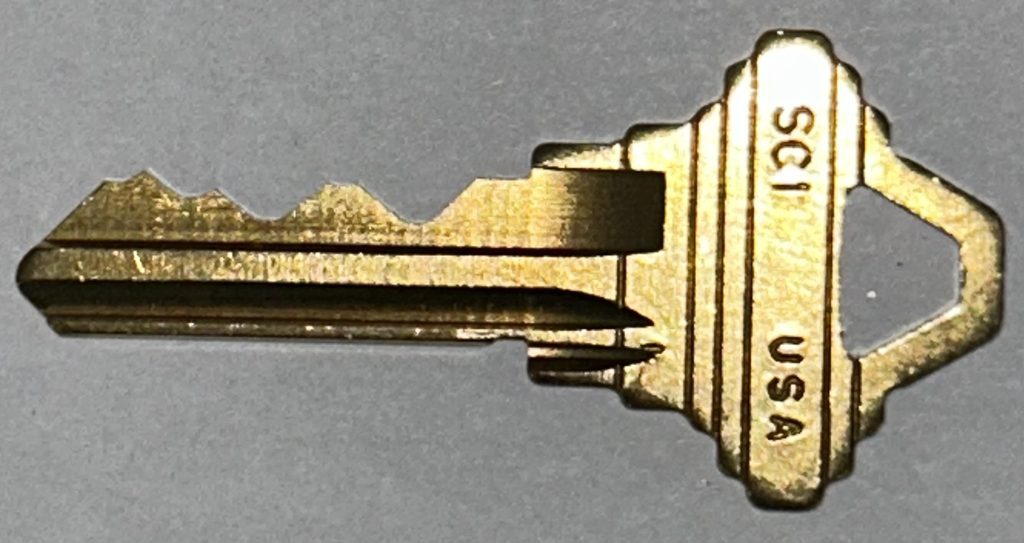
I usually ask the client to remove the key from the keyring, place it on a white background, and take the picture straight on.
You want something like this:
Steps:
- To start, you will measure the height of the proper key blank where it is never cut, usually at the shoulder. On a Schlage, that height is around .341 for an ILCO blank, and it will vary a tiny bit depending on the blank manufacturer. (But a small difference doesn’t matter)

2. Next, print the image the client sent you. The bigger the better, as long as it remains a clear image.
Draw a line across the bottom of the blank (*NA if double sided), at the root of each cut, and at the shoulder.
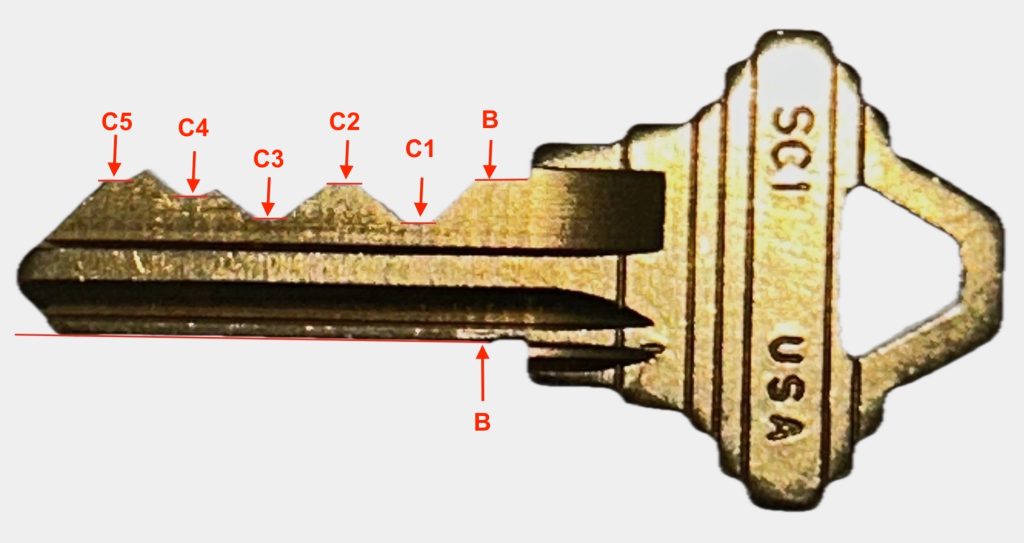
Measure your image with the micrometer at the same spot as you did the original, B in this example.

3. You now have 2 measurements.
The original blank = .341
Your image at the “B” = 1.70 (for example)
We use these two measurements to determine the size ratio between the image and the blank.
A = actual blank = .341
B = Picture = 1.70
A/B = .200
4. Now, measure each cut on your picture and multiply your reading with the ratio you just calculated, .200 in our example.
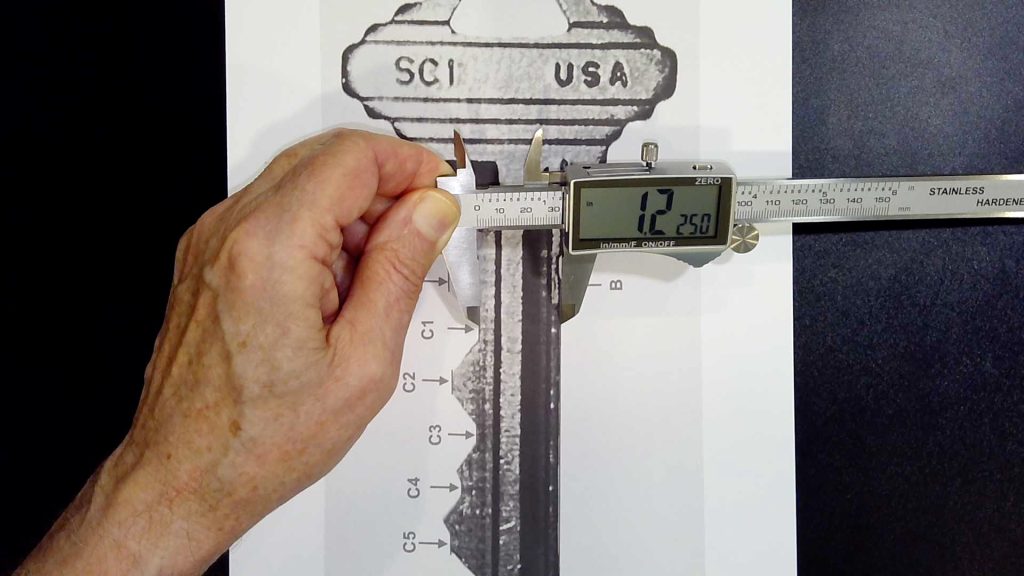
C1 = 1.225 * .200 = .245
Consulting a quick reference, we can see that .245 = #6 Schlage depth.
This is where you might have to fudge a bit. It is rare that you will hit the exact depth, so you have to use your judgment to determine the correct value. The quality of the client image and how large you print it are factors that affect the accuracy.

The formula is;
Cx = R * Cm, where Cx is the cut you are currently measuring, Cm is your image measurement, and R is your previously calculated ratio.
A=actual height of a blank (Schlage is approx .341)
B=measured height of the picture (uncut part of blade, 1.70 for this example)
R=ratio i.e. R=A/B, (.272)
Cx= Cuts = x=1-? cuts as measured on the picture
Cm*R = 1.225 * .200 = .245
Repeat for all cuts. The secret is to get an accurate ratio by measuring an original blank and dividing that by the height of the blank in the picture. The bigger you can make the picture, the more accurate your readings. Multiply the cut measurement by the ratio and you have the cut depth.
So, for the math geeks;
Cx = (A/B) * Cm
Where Cx is the cut dimension you need (C1, C2, etc), A is the height of an actual blank, B is the height of the key in the picture, and Cm is the measurement of each cut in the picture.
Double sided keys
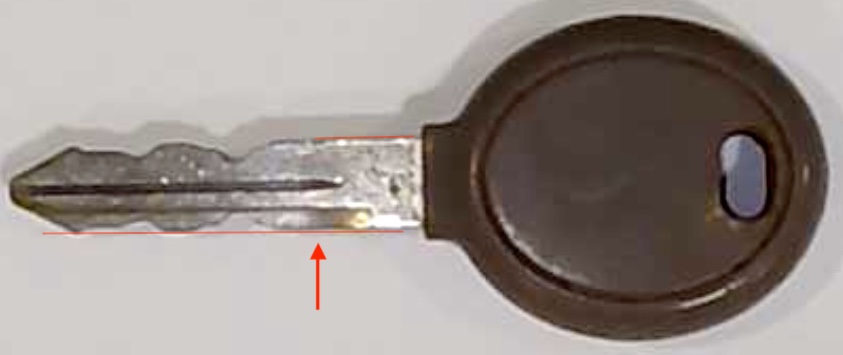
The easiest way to deal with them, if it is a “convenience double sided”, is to draw a line on one side as a reference. Like this:
No Printer? Try this.
If you are in the field, you may not have access to a printer.
Display the picture on your phone, and make it as large as possible (for accuracy).
Freeze it so it doesn’t change (take a screenshot and use it)
Measure it directly from the phone image to get the ratio, and then calculate cut depths.
Some locksmiths have suggested this:
Place a blank on the picture.
Size the client picture to match the blank.
Measure the cuts directly from the resized picture.
(I’ve never had good luck with this because each time you touch the screen, it can affect the picture. Screen shotting it may help.)
So, with the information presented here, feel free to print out my key at the top of this post, calculate the remaining cuts, and post your answer in the comments below.
Jon Payne Sr., CML, CAI